I burned this giant skillet cookie cake four times before I got it right. Not a little brown on the edges—I mean charcoal edges and a raw, doughy center that collapsed into a sad puddle. The fifth time, I sat on my kitchen floor and actually cried into the cast iron. It sounds dramatic, but sometimes baking does that to you. You follow every instruction, you use the right butter temperature, and somehow the thing still comes out wrong.
The problem wasn’t the recipe itself. It was the pan. Skillet cookies are deceptive because the heat distribution in cast iron is nothing like a regular baking sheet. The sides get screaming hot while the middle barely catches up. Once I figured out the trick—lowering the oven temperature and using a specific butter-to-sugar ratio—everything clicked. The cookie cake came out golden all the way through, with that signature crispy edge and a center so soft it barely held together.
This giant skillet chocolate chip cookie cake is the version I make when I want dessert to feel like an event. It’s the kind of thing you pull out of the oven and everyone stops talking. The best part? You don’t need to be a pastry chef to pull it off. You just need patience and a good cast iron pan. And maybe a willingness to fail a few times first.
Why You’ll Love This Recipe
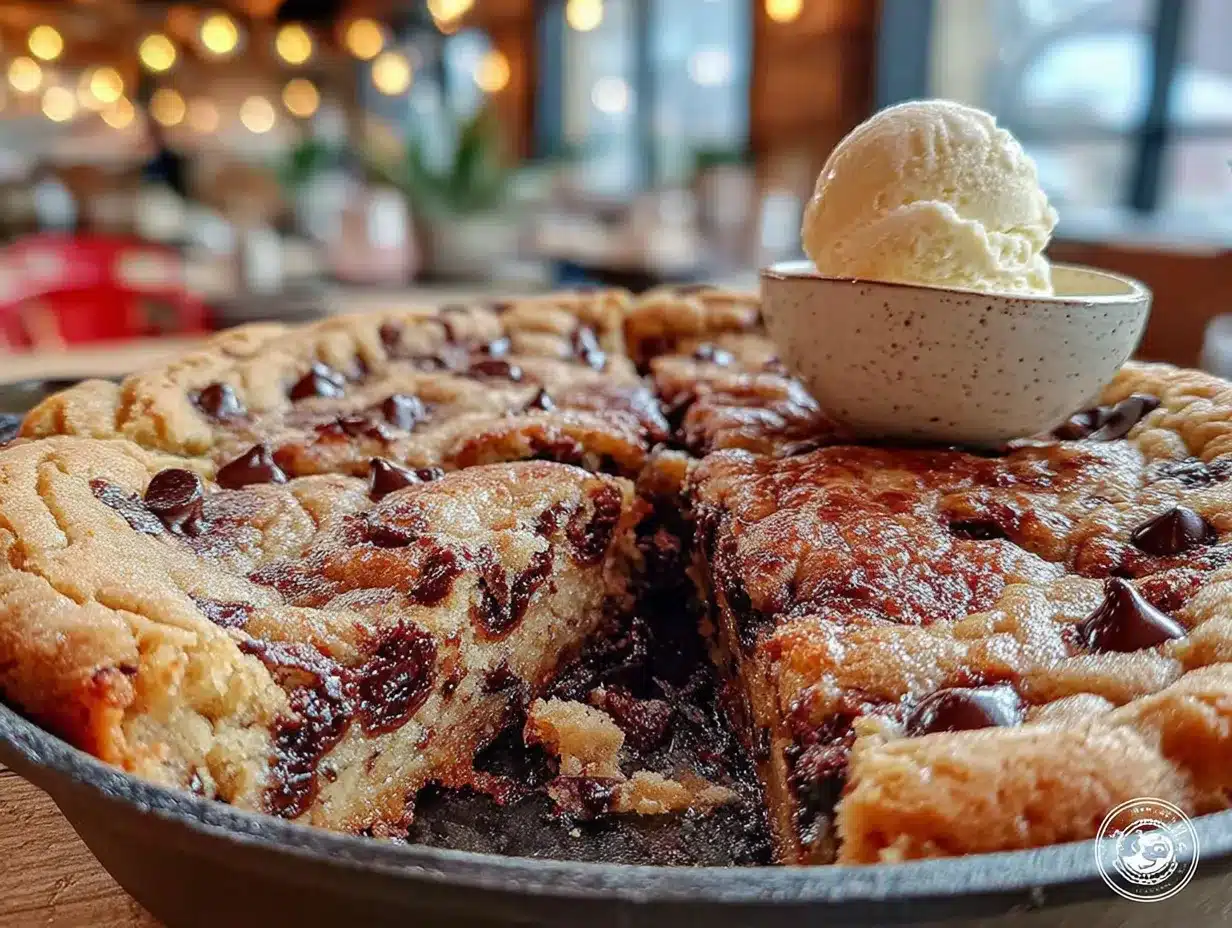
This isn’t just another chocolate chip cookie recipe. It’s a giant, shareable dessert that delivers the perfect texture contrast—crispy golden edges with a soft, almost gooey center. Here’s why this version stands out from every other skillet cookie you’ve tried:
- One-Pan Wonder : Mix the dough in one bowl, bake it in the same skillet you serve it from. Minimal cleanup, maximum impact.
- Perfect Texture Every Time : The secret is the butter-to-sugar ratio and a slightly lower oven temperature that allows the center to cook through without burning the edges.
- Customizable for Any Occasion : Birthday parties, Valentine’s Day, game nights, or just a Tuesday that needs a little sweetness.
- No Chill Time Required : Unlike regular cookie dough that needs hours in the fridge, this dough goes straight into the oven.
- Crowd-Pleasing Size : Serves 8–10 people easily. Perfect for sharing without slicing a dozen individual cookies.
I’ve tested this recipe with different flours, sugars, and even dairy-free butter. The version I’m sharing today is the one that passed every taste test. It’s the kind of cookie cake that makes people close their eyes after the first bite. Honestly, it’s the kind of dessert you make when you want to impress without stressing yourself out.
What Ingredients You Will Need
This recipe relies on simple, pantry-friendly ingredients that work together to create that perfect cookie texture. The quality of your butter and vanilla will make a noticeable difference here, so don’t skimp if you can help it.
- Unsalted butter, softened – 1 cup (2 sticks / 226g). Use good quality butter like Kerrygold or Plugrà for richer flavor. Softened means left at room temperature for about an hour—not melted, not microwaved.
- Light brown sugar, packed – 1 cup (200g). This gives the cookie its chewy texture and deep caramel notes. Dark brown sugar works too but will make the cookie slightly more molasses-forward.
- Granulated sugar – ½ cup (100g). Adds crispness to the edges and balances the brown sugar.
- Large eggs – 2, at room temperature. Cold eggs will seize the butter and make the dough stiff. Leave them on the counter for 30 minutes or place them in warm water for 5 minutes.
- Vanilla extract – 2 teaspoons. Pure vanilla extract, not imitation. It makes a real difference in the flavor depth.
- All-purpose flour – 2 ¼ cups (280g). Spoon and level your flour—don’t scoop directly from the bag or you’ll end up with a dry, crumbly dough.
- Baking soda – 1 teaspoon. Helps the cookie spread evenly without puffing up too much.
- Salt – 1 teaspoon. Use fine sea salt for the dough. Flaky salt for finishing on top.
- Semi-sweet chocolate chips – 2 cups (340g). I use Guittard or Ghirardelli for the best melt. You can also chop a dark chocolate bar for bigger puddles of chocolate.
- Optional for topping – Flaky sea salt (like Maldon), extra chocolate chips for pressing into the warm cookie, vanilla ice cream for serving.
If you need a dairy-free version, use plant-based butter sticks (not spreadable margarine) and vegan chocolate chips. The texture will be slightly less tender but still delicious. For a gluten-free option, swap the all-purpose flour with a 1:1 gluten-free baking blend that contains xanthan gum.
Equipment Needed
You don’t need a lot of fancy tools for this recipe, but a few key pieces make the process smoother.
- 10-inch cast iron skillet – This is non-negotiable for the perfect crispy edges. Lodge makes affordable, reliable skillets. If you don’t have cast iron, use a 10-inch oven-safe nonstick skillet (check that the handle can handle 350°F).
- Mixing bowls – One large bowl for the wet ingredients, one medium bowl for the dry ingredients.
- Hand mixer or stand mixer – A hand mixer works perfectly. You can also mix by hand with a wooden spoon, but your arm will get a workout.
- Rubber spatula – For scraping down the bowl and folding in the chocolate chips.
- Measuring cups and spoons – Accurate measurements matter in baking. Use dry measuring cups for flour and sugar, liquid measuring cups for vanilla.
- Kitchen scale – Optional but recommended. Weighing your flour eliminates the guesswork and gives you consistent results every time.
I’ve made this cookie cake in a well-seasoned cast iron that I’ve had for years and in a cheap nonstick pan from the grocery store. The cast iron version wins every time—the heat retention creates that perfect golden crust that makes the edges taste like the best part of a chocolate chip cookie.
Preparation Method
Preheat your oven to 350°F (175°C). Place your cast iron skillet inside while the oven heats up—this preheating step is crucial for getting those crispy edges.
- Cream the butter and sugars – In a large mixing bowl, beat the softened butter, brown sugar, and granulated sugar together on medium speed for 3–4 minutes until light and fluffy. Scrape down the sides of the bowl halfway through. The mixture should look pale and airy, almost like a thick frosting. Don’t rush this step—proper creaming adds air that helps the cookie rise evenly.
- Add the eggs and vanilla – Beat in the eggs one at a time, mixing well after each addition. Add the vanilla extract and mix until combined. The mixture might look slightly curdled at this point—that’s normal if your eggs were cold. It will come together once you add the flour.
- Combine the dry ingredients – In a separate bowl, whisk together the flour, baking soda, and salt. This ensures the baking soda is evenly distributed so you don’t get a weird salty pocket in your cookie cake.
- Mix the dry into the wet – Gradually add the flour mixture to the butter mixture, mixing on low speed until just combined. Stop as soon as you no longer see streaks of flour. Overmixing at this stage develops gluten and makes the cookie tough.
- Fold in the chocolate chips – Use a rubber spatula to fold in the chocolate chips by hand. Make sure they’re evenly distributed throughout the dough. Reserve about ¼ cup of chips to press into the top after baking.
- Transfer the dough to the skillet – Carefully remove the hot skillet from the oven (use oven mitts!). Press the cookie dough evenly into the skillet. Don’t worry about spreading it perfectly—just pat it down into an even layer. The dough will be thick.
- Bake the cookie cake – Place the skillet in the oven and bake for 22–28 minutes. Start checking at 22 minutes. The edges should be golden brown and set, while the center will still look slightly soft and puffy. A toothpick inserted into the center should come out with a few moist crumbs—not raw batter.
- Cool and add toppings – Remove the skillet from the oven and place it on a wire rack. Immediately press the reserved chocolate chips into the warm surface. Sprinkle with flaky sea salt if you’re using it. Let the cookie cake cool in the skillet for at least 15 minutes before serving. It will continue to set as it cools.
One thing I learned the hard way: don’t overbake this cookie cake. It’s better to pull it out when the center looks slightly underdone because the residual heat from the skillet will continue cooking it. If you wait until the center looks fully set, you’ll end up with a dry, cake-like texture instead of a soft, chewy cookie.
Cooking Tips & Techniques
After burning through four batches of this giant skillet chocolate chip cookie cake, I picked up a few tricks that make all the difference.
Temperature matters more than you think. Your butter should be soft but not melted. If it’s too warm, the cookie will spread too much and turn into a flat, greasy disc. If it’s too cold, it won’t cream properly and the texture will be dense. The sweet spot is when you can press your finger into the butter and it leaves an indent without sliding through.
Preheat the skillet. This is the tip that finally fixed my burned edges problem. Putting the cold skillet in the oven while it preheats means the pan is already hot when the dough hits it. The edges start cooking immediately, creating that crispy crust while the center stays soft. Just remember to use oven mitts when handling the hot skillet—I learned that lesson the hard way too.
Don’t skip the flaky salt. I know it sounds like a fancy garnish, but the salt does more than look pretty. It cuts through the sweetness and enhances the chocolate flavor. Without it, the cookie cake tastes one-dimensional. With it, every bite has a little spark of contrast.
Let it rest before serving. I know it’s tempting to dig in right away, but the cookie cake needs time to set. If you cut into it while it’s still hot, it will fall apart. Fifteen minutes of patience gives you clean slices and a texture that holds together beautifully.
Variations & Adaptations
This recipe is incredibly forgiving when it comes to customization. Here are a few variations I’ve tested in my own kitchen:
- Double Chocolate Skillet Cookie – Replace ¼ cup of the all-purpose flour with ¼ cup of unsweetened cocoa powder. Use dark chocolate chips instead of semi-sweet. The result is a rich, fudgy cookie that tastes like a brownie’s older sibling.
- Peanut Butter Swirl – Warm ⅓ cup of creamy peanut butter in the microwave for 20 seconds. Drop spoonfuls over the pressed dough and swirl it in with a knife before baking. Add peanut butter chips along with the chocolate chips for extra texture.
- Gluten-Free Version – Use a 1:1 gluten-free baking blend like King Arthur Measure for Measure. Add an extra tablespoon of milk to the dough since gluten-free flours tend to absorb more moisture. The texture will be slightly more tender but still delicious.
- Vegan Adaptation – Substitute the butter with plant-based sticks (I like Earth Balance) and use two flax eggs (2 tablespoons ground flaxseed mixed with 6 tablespoons warm water, let sit for 5 minutes). Use vegan chocolate chips. The cookie will be a bit less chewy but still very satisfying.
- Holiday Twist – Swap the semi-sweet chips with white chocolate chips and add ½ cup of dried cranberries or chopped dried cherries. It’s perfect for Christmas or Valentine’s Day.
My personal favorite variation is the peanut butter swirl. I made it for a Super Bowl party last year and the skillet was empty within twenty minutes. Something about the salty peanut butter against the sweet chocolate just hits different.
Serving & Storage Suggestions
This giant skillet chocolate chip cookie cake is best served warm, straight from the skillet. Scoop a generous portion onto a plate and top it with a scoop of vanilla ice cream. The cold ice cream melting over the warm cookie is the kind of simple pleasure that makes everything feel right.
For a more dressed-up presentation, drizzle the warm cookie with caramel sauce or chocolate ganache. Add fresh berries on the side for color and a little tartness. If you’re serving it at a party, set the skillet on a trivet in the center of the table with a stack of small plates and forks—let everyone dig in family-style.
Storage: Cover the cooled skillet tightly with foil or plastic wrap. Store at room temperature for up to 3 days. The texture will soften slightly over time, but the flavor actually improves after a day.
Reheating: Place the skillet in a 300°F oven for 5–7 minutes to warm through. You can also microwave individual slices for 15–20 seconds, but the edges won’t be as crispy. If you have leftovers (unlikely, but possible), you can crumble the cookie over ice cream or yogurt for a quick dessert the next day.
Freezing: The unbaked dough freezes beautifully. Press it into the skillet, wrap it tightly in plastic wrap and foil, and freeze for up to 3 months. Bake directly from frozen, adding 5–8 minutes to the baking time. You can also freeze the baked cookie cake—just wrap it well and thaw at room temperature before reheating.
Nutritional Information & Benefits
Let’s be honest—this is a dessert, not a health food. But knowing what’s in it helps you enjoy it mindfully.
Per serving (based on 10 servings): approximately 480 calories, 24g fat, 62g carbohydrates, 6g protein, 38g sugar, 2g fiber. These values will vary based on your specific ingredients and any modifications.
The dark chocolate chips provide a small amount of antioxidants and magnesium. The butter and eggs offer vitamin A and protein. If you use flaky sea salt, you’re getting trace minerals. But really, this cookie cake is about joy, not nutrition. It’s the kind of treat you share with people you love, and that has its own kind of value.
If you’re watching your sugar intake, you can reduce the granulated sugar by ¼ cup without significantly affecting the texture. Just know that the edges won’t be quite as crispy. For a lower-calorie option, serve smaller slices with extra berries on the side.
Conclusion
This giant skillet chocolate chip cookie cake is the dessert I turn to when I want something that feels special without requiring a pastry degree. It’s forgiving enough for beginners, impressive enough for company, and delicious enough to make you forget about the four burned batches that came before it.
I love this recipe because it reminds me that failure is part of the process. Every burned cookie taught me something—about heat distribution, about butter temperature, about patience. And now I get to share what I learned so you can skip straight to the good part.
If you make this cookie cake, I want to hear about it. Leave a comment below and tell me how it turned out. Did you add a twist? Did you serve it with ice cream? Did your family fight over the last piece? Share your photos and tag me on social media—I love seeing your kitchen victories.
Go ahead, preheat that oven. Your skillet is waiting.
Frequently Asked Questions
Can I use a regular cake pan instead of a cast iron skillet?
Yes, but the texture will be different. A cast iron skillet retains heat better and creates those crispy edges that make this cookie cake special. If you use a regular 10-inch cake pan, reduce the baking time by 2–3 minutes and expect a softer, more uniform texture. For a similar effect, try an oven-safe nonstick skillet.
Why is my cookie cake raw in the middle?
This usually happens for one of three reasons: the oven temperature is too high (the edges cook too fast while the center stays raw), the skillet wasn’t preheated, or the dough was too thick. Try lowering your oven temperature to 340°F and preheating the skillet. Also make sure you’re pressing the dough into an even layer—if it’s thicker in the center, it won’t cook evenly.
Can I make this cookie cake ahead of time?
Absolutely. You can prepare the dough up to 2 days in advance and keep it covered in the refrigerator. Let it sit at room temperature for 15 minutes before pressing it into the skillet (cold dough won’t spread as well). You can also freeze the unbaked dough in the skillet for up to 3 months—just wrap it tightly and bake from frozen, adding 5–8 minutes to the baking time.
What’s the best way to reheat leftover cookie cake?
The oven method works best. Place the skillet in a 300°F oven for 5–7 minutes. The edges will crisp back up and the center will get warm and gooey again. If you’re in a hurry, microwave individual slices for 15–20 seconds, but the edges won’t be as crispy. For a quick treat, crumble cold cookie cake over vanilla ice cream.
Can I use different types of chocolate chips?
Definitely. Milk chocolate chips will make the cookie cake sweeter and softer. Dark chocolate chips (60–70% cacao) add a deeper, more sophisticated flavor. White chocolate chips create a completely different profile—try them with dried cranberries for a holiday twist. You can even chop up a chocolate bar for bigger puddles of melted chocolate throughout the cookie.
If you enjoyed this giant skillet chocolate chip cookie cake, you might also love my brown butter snickerdoodle crinkle cookies for another easy, shareable dessert. For something fruity, my fresh peach dump cake with brown butter is a summer favorite. And if you’re feeding a crowd, my no-bake strawberry cheesecake icebox cake is perfect for hot days when you don’t want to turn on the oven.
Pin This Recipe!
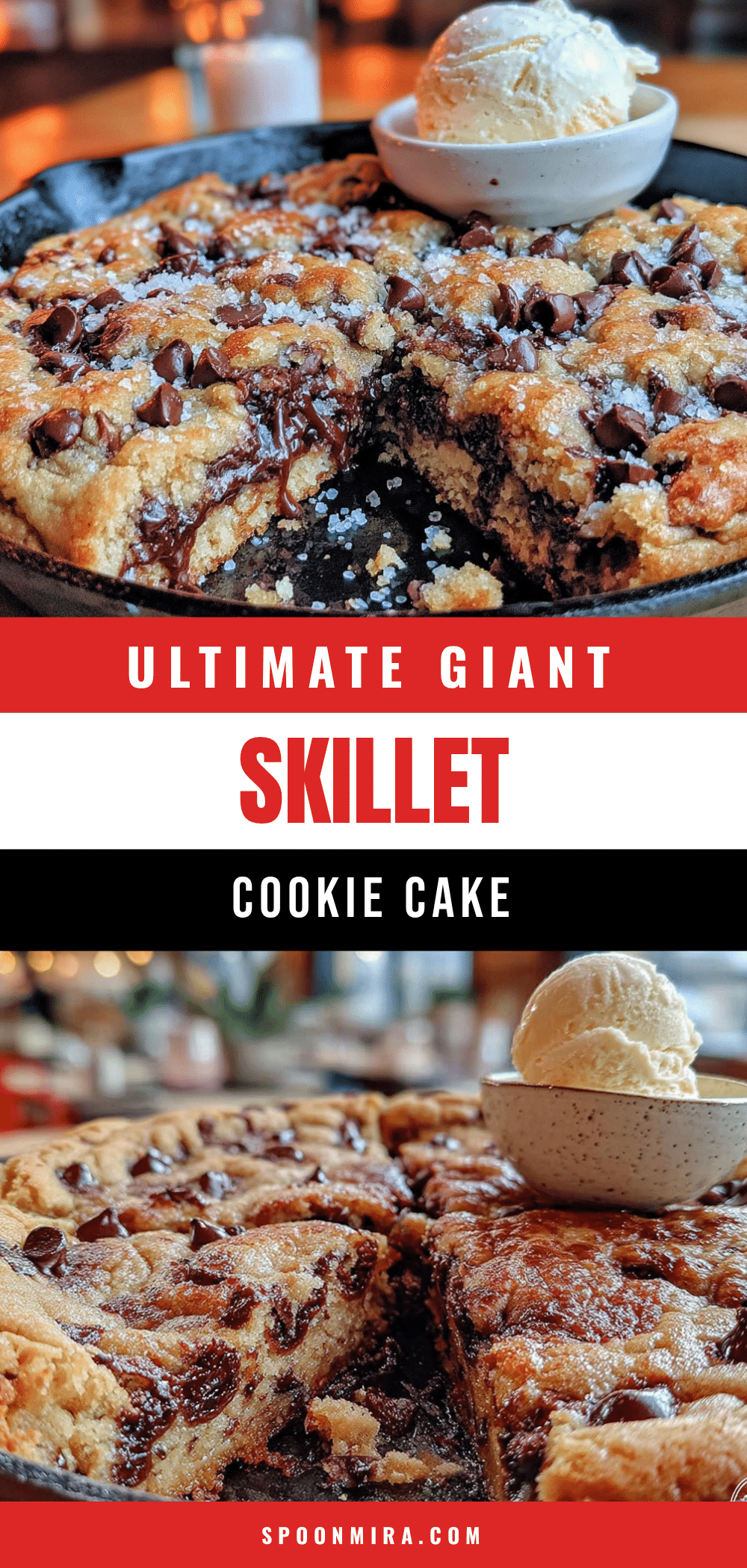
Best Giant Skillet Chocolate Chip Cookie Cake Recipe
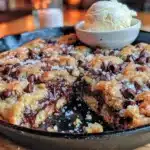
This giant skillet chocolate chip cookie cake delivers crispy golden edges with a soft, gooey center. It’s a one-pan wonder that requires no chill time and serves 8–10 people, perfect for any occasion.
- Prep Time: 15 minutes
- Cook Time: 25 minutes
- Total Time: 40 minutes
- Yield: 8-10 servings 1x
- Category: Dessert
- Cuisine: American
Ingredients
- 1 cup (2 sticks / 226g) unsalted butter, softened
- 1 cup (200g) light brown sugar, packed
- ½ cup (100g) granulated sugar
- 2 large eggs, at room temperature
- 2 teaspoons pure vanilla extract
- 2 ¼ cups (280g) all-purpose flour
- 1 teaspoon baking soda
- 1 teaspoon fine sea salt
- 2 cups (340g) semi-sweet chocolate chips
- Flaky sea salt (optional, for topping)
- Vanilla ice cream (optional, for serving)
Instructions
- Preheat your oven to 350°F (175°C). Place your 10-inch cast iron skillet inside while the oven heats up to preheat the skillet.
- In a large mixing bowl, beat the softened butter, brown sugar, and granulated sugar together on medium speed for 3–4 minutes until light and fluffy. Scrape down the sides of the bowl halfway through.
- Beat in the eggs one at a time, mixing well after each addition. Add the vanilla extract and mix until combined.
- In a separate bowl, whisk together the flour, baking soda, and salt.
- Gradually add the flour mixture to the butter mixture, mixing on low speed until just combined. Do not overmix.
- Fold in the chocolate chips using a rubber spatula. Reserve about ¼ cup of chips to press into the top after baking.
- Carefully remove the hot skillet from the oven. Press the cookie dough evenly into the skillet.
- Bake for 22–28 minutes, starting to check at 22 minutes. The edges should be golden brown and set, while the center will still look slightly soft and puffy. A toothpick inserted into the center should come out with a few moist crumbs.
- Remove the skillet from the oven and place it on a wire rack. Immediately press the reserved chocolate chips into the warm surface. Sprinkle with flaky sea salt if desired.
- Let the cookie cake cool in the skillet for at least 15 minutes before serving.
Notes
Don’t overbake the cookie cake; it’s better to pull it out when the center looks slightly underdone because the residual heat from the skillet will continue cooking it. Preheat the skillet for crispy edges. Let the cookie cake rest for 15 minutes before serving to allow it to set.
Nutrition
- Serving Size: 1 slice (based on 10
- Calories: 480
- Sugar: 38
- Sodium: 320
- Fat: 24
- Saturated Fat: 14
- Carbohydrates: 62
- Fiber: 2
- Protein: 6
Keywords: skillet cookie, chocolate chip cookie cake, giant cookie, cast iron dessert, one-pan dessert