The woman at the farmers’ market stall watched me pick up and put down the same Meyer lemon three times. I was circling that bin like a confused bird, honestly, trying to decide if I really needed another bag of citrus when I already had a bag of regular lemons at home. She didn’t say anything at first. Then she reached over, picked one up herself, and handed it to me with a little nod. “These are different,” she said. “Sweeter. Almost floral. You’ll want to bake something that lets them shine.”
I took the lemon home, and it sat on my counter for two days while I thought about what to do with it. I mean, I could have just made regular lemon cake. But something about that exchange—the quiet confidence of her words, the way she didn’t try to sell me anything—made me want to treat this particular fruit with a little more intention. So I grabbed my best olive oil, the one I usually save for dipping bread, and started playing around. The first cake came out okay. The second came out good. The third? That one made me close my eyes after the first bite, and I knew I had something worth sharing.
This Light and Sunny Meyer Lemon Olive Oil Cake with Honey Glaze is what happened when I stopped trying to force the lemon to behave like a regular lemon and just let it be what it was. Maybe you’ve been there—standing in a grocery aisle or at a market, holding an ingredient that feels special, wondering if you’ll do it justice. Let me tell you, this cake is the kind of recipe that makes you look like a hero with almost no effort. It’s bright without being tart, moist without being heavy, and that honey glaze? Honestly, it’s the kind of thing you’ll want to drizzle on everything for a week.
Three winters ago, I made this for a friend who was having a rough month, and she called me the next day to say she’d eaten half the cake standing over the kitchen sink at midnight. That’s the kind of recipe this is. It stays with you.
Why You’ll Love This Recipe
Let’s be real for a second—there are a million lemon cake recipes out there. What makes this one different? I’ve tested this cake at least a dozen times, tweaking the oil ratio, adjusting the honey, even trying different types of olive oil to see what worked best. Here’s what I found:
- Quick & Easy: This comes together in about 15 minutes of active prep time. No stand mixer required, no complicated techniques. Just a bowl, a whisk, and some patience while it bakes.
- Simple Ingredients: You probably have most of these in your pantry right now. The only special guest is the Meyer lemon, and honestly, regular lemons work too—though the flavor won’t be quite as floral.
- Perfect for Spring Gatherings: This cake was made for sunny afternoons, brunch tables, and Easter dinners. It’s light enough for a warm day but satisfying enough to feel like a real dessert.
- Crowd-Pleaser: I’ve brought this to three different potlucks, and every single time, someone asked for the recipe. Even people who “don’t like olive oil cake” (a thing, apparently) have gone back for seconds.
- Unbelievably Delicious: The texture is what gets people. It’s tender and moist with a slightly denser crumb than butter cake, but it doesn’t feel heavy. The olive oil adds a subtle fruitiness that plays off the bright lemon perfectly.
What sets this recipe apart is the technique of whisking the olive oil into the sugar and eggs until it’s completely emulsified. This isn’t just another lemon cake—it’s the one where the olive oil does the heavy lifting, creating a texture that stays moist for days. And that honey glaze? It soaks into the warm cake just enough to add sweetness without making it soggy.
This is the kind of cake that makes you feel like you’re eating something fancy, but it’s really just simple ingredients treated with a little love. Perfect for impressing guests without stress, or turning a regular Tuesday into something worth remembering.
What Ingredients You Will Need
This recipe uses simple, wholesome ingredients to deliver bright flavor and a tender crumb without any fuss. Most of these are pantry staples, but a few deserve a little extra attention.
- Meyer lemons (2-3 medium): These are the star of the show. Meyer lemons are sweeter and less acidic than regular lemons, with a hint of floral flavor. You’ll need both the zest and the juice. If you can’t find Meyer lemons, regular lemons work—just reduce the sugar slightly and add a tiny pinch of orange zest to mimic that floral note.
- Extra-virgin olive oil (¾ cup / 180 ml): Use a good-quality olive oil here, but not your most expensive finishing oil. You want something fruity and mild, not overly peppery. I personally love California Olive Ranch for baking—it’s smooth and doesn’t overpower the lemon.
- Honey (⅓ cup / 110 g, plus more for glaze): Local honey is ideal if you can find it. The honey adds sweetness and a subtle floral undertone that pairs beautifully with the Meyer lemon. For the glaze, you’ll need about 3 tablespoons more.
- Granulated sugar (¾ cup / 150 g): Regular white sugar works best here. It helps create that tender crumb and balances the lemon’s brightness.
- Large eggs (3, at room temperature): Room-temperature eggs emulsify better with the oil, giving you a smoother batter. If you forgot to take them out of the fridge, place them in a bowl of warm water for 5 minutes.
- All-purpose flour (1½ cups / 190 g): Standard all-purpose flour gives the cake structure without making it tough. For a gluten-free version, use a 1:1 gluten-free baking flour blend—I’ve had good luck with Bob’s Red Mill.
- Baking powder (1½ teaspoons): This is your leavening agent. Make sure it’s fresh—test it by dropping a little into hot water; if it fizzes, you’re good.
- Salt (¼ teaspoon): Just a pinch to balance the sweetness and enhance the lemon flavor.
- Plain Greek yogurt (½ cup / 120 g): This adds moisture and a slight tang that complements the olive oil. Full-fat works best, but 2% is fine too. For a dairy-free option, use a plain coconut or almond yogurt.
- Powdered sugar (1 cup / 120 g, for glaze): This creates that smooth, pourable glaze. Sift it first to avoid lumps.
- Optional garnish: fresh thyme sprigs or edible flowers: Not necessary, but they make the cake look gorgeous for photos or special occasions.
Equipment Needed
You don’t need a lot of fancy tools for this cake, which is part of why I love it. Here’s what you’ll need:
- 9-inch round cake pan: A standard metal or non-stick pan works well. Glass or ceramic will work too, but you may need to add 5-10 minutes to the baking time.
- Parchment paper: Cut a circle for the bottom of the pan and grease the sides. This ensures your cake comes out clean every time.
- Large mixing bowl and whisk: You can use a hand mixer if you want, but honestly, a whisk does the job perfectly and gives you more control.
- Microplane or fine zester: This is essential for getting that fine lemon zest without the bitter white pith. A box grater works in a pinch, but the microplane is worth the investment.
- Citrus juicer: A simple handheld juicer makes getting every drop of juice much easier. I’ve used the back of a fork in a pinch, but it’s messy.
- Small saucepan (for glaze): You’ll warm the honey and lemon juice gently before whisking in the powdered sugar.
- Cooling rack: Letting the cake cool completely on a rack prevents a soggy bottom. If you don’t have one, flip a muffin tin upside down and use that.
Budget-friendly tip: You can skip the parchment paper and just grease the pan well with butter and a dusting of flour. It works, but the parchment gives you that extra insurance against sticking.
Preparation Method

Preheat your oven to 350°F (175°C). Grease your 9-inch round cake pan and line the bottom with a circle of parchment paper. Set it aside while you make the batter.
- Zest and juice the lemons. Start by zesting 2 Meyer lemons using your microplane. Be careful to only get the yellow part—the white pith is bitter. Then juice those same lemons until you have ¼ cup (60 ml) of fresh juice. Set both aside. You’ll use the zest in the batter and the juice in both the batter and the glaze.
- Whisk the wet ingredients. In a large mixing bowl, combine ¾ cup (150 g) granulated sugar and the lemon zest. Use your fingers to rub the zest into the sugar until it’s fragrant and slightly damp—this releases the lemon oils and gives you maximum flavor. Add 3 large room-temperature eggs and whisk vigorously for about 1 minute until the mixture is pale and slightly thick. You’re looking for a ribbon-like consistency when you lift the whisk.
- Add the olive oil and yogurt. Slowly drizzle in ¾ cup (180 ml) olive oil while whisking continuously. This emulsification step is crucial—if you dump the oil in all at once, the batter can separate. Keep whisking until the mixture is smooth and glossy. Then whisk in ½ cup (120 g) Greek yogurt and 2 tablespoons of the Meyer lemon juice. The batter will look a little thin at this point, and that’s okay.
- Fold in the dry ingredients. In a separate small bowl, whisk together 1½ cups (190 g) all-purpose flour, 1½ teaspoons baking powder, and ¼ teaspoon salt. Add the dry ingredients to the wet mixture in two additions, folding gently with a rubber spatula after each. Mix just until you no longer see streaks of flour—overmixing will make the cake tough. A few small lumps are fine.
- Pour and bake. Pour the batter into your prepared pan and smooth the top with the spatula. Bake for 35-40 minutes, or until a toothpick inserted in the center comes out clean or with just a few moist crumbs. The top should be golden brown and spring back when lightly touched. My oven runs a little hot, so I start checking at 32 minutes.
- Make the honey glaze. While the cake bakes, make the glaze. In a small saucepan over low heat, warm 3 tablespoons honey and 1 tablespoon Meyer lemon juice until runny—about 30 seconds. Remove from heat and whisk in 1 cup (120 g) sifted powdered sugar until smooth. If the glaze is too thick, add another teaspoon of lemon juice. If it’s too thin, add a little more powdered sugar.
- Glaze while warm. When the cake comes out of the oven, let it cool in the pan for 10 minutes. Then run a knife around the edges, invert onto a cooling rack, and peel off the parchment. While the cake is still warm (but not hot), pour the glaze over the top. Use the back of a spoon to spread it gently to the edges—the warmth will help it soak in slightly. Let the cake cool completely before slicing.
A note from my kitchen: The first time I made this, I got impatient and glazed the cake while it was still too hot. The glaze slid right off and pooled on the rack. Let it cool those 10 minutes—trust me on this one.
Cooking Tips & Techniques
After making this cake more times than I care to admit, I’ve picked up a few tricks that make a real difference. Here’s what I wish someone had told me:
Bring everything to room temperature. I know, I know—every recipe says this. But with olive oil cakes, it actually matters. Cold eggs and cold yogurt can cause the oil to seize up, leaving you with a dense, greasy cake. Take everything out of the fridge an hour before you start. If you forgot, place the eggs in warm water for 5 minutes and microwave the yogurt for 10 seconds.
Don’t skip the zest-sugar rub. This is one of those tiny steps that feels unnecessary but completely transforms the flavor. Rubbing the zest into the sugar releases the essential oils and distributes the lemon flavor evenly throughout the cake. Without this step, you’ll end up with pockets of zest and a less pronounced lemon taste.
Watch your baking time. Ovens vary wildly. I’ve made this cake in three different ovens, and the baking time ranged from 33 to 42 minutes. Start checking at 30 minutes. The cake is done when the edges pull away slightly from the pan and the center is set. A toothpick test is your best friend here.
Let it cool properly. I learned this the hard way after slicing into a cake too early and watching it crumble into a delicious but ugly mess. The cake needs time to set as it cools. If you can resist, let it cool completely—about 2 hours. The texture firms up and the glaze sets into a beautiful, slightly crackly top.
Store it right. This cake stays moist for days if stored properly. Wrap it tightly in plastic wrap or keep it in an airtight container at room temperature. Do not refrigerate—the cold will dry it out. It actually tastes better on day two, once the flavors have had time to meld.
Variations & Adaptations
One of the things I love about this recipe is how flexible it is. Here are a few variations I’ve tried and loved:
Gluten-Free Version: Swap the all-purpose flour with a 1:1 gluten-free baking blend. I’ve used Bob’s Red Mill and King Arthur Measure for Measure with great results. Add ¼ teaspoon xanthan gum if your blend doesn’t already include it. The texture will be slightly more delicate, so handle the cake gently when removing it from the pan.
Dairy-Free Version: Replace the Greek yogurt with a plain dairy-free yogurt—coconut or almond work well. The cake will be slightly less tangy, so add an extra teaspoon of lemon zest to compensate. Use a vegan butter alternative for greasing the pan.
Herb-Infused Version: Add 1 tablespoon of finely chopped fresh rosemary or thyme to the batter along with the dry ingredients. The herbal notes pair beautifully with the olive oil and lemon. I made this for a dinner party last fall, and everyone kept asking what the “secret ingredient” was.
Berry Swirl Version: Before baking, drop spoonfuls of raspberry or blueberry jam onto the batter and swirl gently with a knife. The tart berries cut through the sweetness and add beautiful color. Just don’t over-swirl, or you’ll lose the marbled effect.
Mini Loaf Version: Divide the batter among 4 mini loaf pans and reduce the baking time to 22-25 minutes. These make adorable gifts and freeze beautifully. I’ve done this for holiday neighbor gifts, and they’re always a hit.
Serving & Storage Suggestions
This cake is wonderful at room temperature, but I actually prefer it slightly warm—the honey glaze gets a little melty, and the texture is incredibly tender. If you’re serving it the same day, let it cool completely on the rack, then slice and serve.
For presentation, I like to place the cake on a simple white platter and garnish with a few fresh thyme sprigs and thin lemon slices. Edible flowers like pansies or violets add a beautiful pop of color if you’re serving it for a special occasion. A dusting of powdered sugar never hurts either.
This cake pairs beautifully with a cup of Earl Grey tea or a light, floral white wine like a Riesling or Moscato. For brunch, serve it alongside fresh berries and a dollop of whipped cream or Greek yogurt.
Storage: Store the cake in an airtight container at room temperature for up to 4 days. Do not refrigerate—the cold air will dry out the cake and dull the flavors. If you live in a humid climate, the glaze might get slightly sticky; just pat it dry with a paper towel before serving.
Freezing: This cake freezes beautifully. Wrap the unglazed cake tightly in plastic wrap, then in aluminum foil, and freeze for up to 3 months. When you’re ready to serve, thaw it at room temperature, then make the glaze fresh and pour it over the top. The glaze doesn’t freeze well, so always add it after thawing.
Reheating: To revive day-old cake, pop individual slices in a 300°F (150°C) oven for 5-7 minutes. The warmth brings back that just-baked tenderness. Avoid the microwave—it makes the cake rubbery and melts the glaze into a puddle.
Nutritional Information & Benefits
Here’s the thing about this cake—it’s not health food, but it’s made with real, wholesome ingredients that make you feel good about eating it. The olive oil provides heart-healthy monounsaturated fats, and the Meyer lemons are packed with vitamin C and antioxidants. The Greek yogurt adds protein and probiotics, while the honey offers natural sweetness with a lower glycemic impact than refined sugar.
Per slice (based on 10 servings):
- Calories: 320
- Fat: 18g (mostly from olive oil)
- Carbohydrates: 38g
- Protein: 5g
- Fiber: 1g
- Sugar: 24g
This cake is naturally vegetarian and can be made gluten-free and dairy-free with the substitutions listed above. It contains eggs and dairy (if using Greek yogurt), so it’s not suitable for vegan diets without further modification. The Meyer lemons add a bright, sunny flavor that makes this cake feel like a treat, not a compromise.
From a wellness perspective, I love that this cake uses olive oil instead of butter. It’s a small swap that makes a big difference in both texture and nutritional profile. Plus, the honey glaze means you’re using less refined sugar than a typical lemon cake. It’s the kind of dessert that fits into a balanced lifestyle without making you feel like you’re missing out.
Conclusion
This Light and Sunny Meyer Lemon Olive Oil Cake with Honey Glaze is one of those recipes that proves simple ingredients, treated with care, can create something truly special. It’s bright without being tart, moist without being heavy, and that honey glaze adds just the right amount of sweetness to make every bite feel like a celebration.
I love this recipe because it’s forgiving enough for a beginner baker but impressive enough for a dinner party. It’s the cake I bring when I want to look like I spent hours in the kitchen, when really I just whisked a few things together and let the oven do the work. It’s the cake that makes people close their eyes after the first bite, and honestly, that never gets old.
I’d love to hear how this turns out for you. Did you try any of the variations? Did you add your own twist? Drop a comment below and let me know—I read every single one, and your feedback helps me create better recipes for all of us. And if you loved it, share it with a friend who needs a little sunshine in their kitchen.
Happy baking, friends. May your kitchen smell like lemons and honey.
Frequently Asked Questions
Can I use regular lemons instead of Meyer lemons?
Absolutely. Meyer lemons are sweeter and more floral, but regular lemons work perfectly fine. Just reduce the sugar in the batter by 2 tablespoons to balance the extra acidity, and consider adding a teaspoon of orange zest to mimic that floral note.
Why did my cake sink in the middle?
This usually happens for one of three reasons: the oven door was opened too early, the cake was underbaked, or the baking powder was old. Make sure your baking powder is fresh, resist the urge to peek until the 30-minute mark, and always check with a toothpick before pulling it out.
Can I make this cake ahead of time?
Yes! This cake actually tastes better on day two. Bake it a day ahead, let it cool completely, and store it wrapped tightly at room temperature. Make the glaze fresh on the day you plan to serve it for the best texture and appearance.
My glaze turned out too thick/thin. How do I fix it?
If the glaze is too thick, add warm lemon juice or honey one teaspoon at a time until it reaches a pourable consistency. If it’s too thin, whisk in a little more sifted powdered sugar. The ideal glaze should slowly drizzle off the spoon but still hold its shape slightly on the cake.
Can I use a different type of oil?
You can, but the flavor and texture will change. Olive oil is what gives this cake its signature moist crumb and fruity undertone. Avocado oil is the best substitute—it has a neutral flavor and similar fat profile. Vegetable or canola oil will work in a pinch, but the cake won’t have the same depth of flavor.
Pin This Recipe!
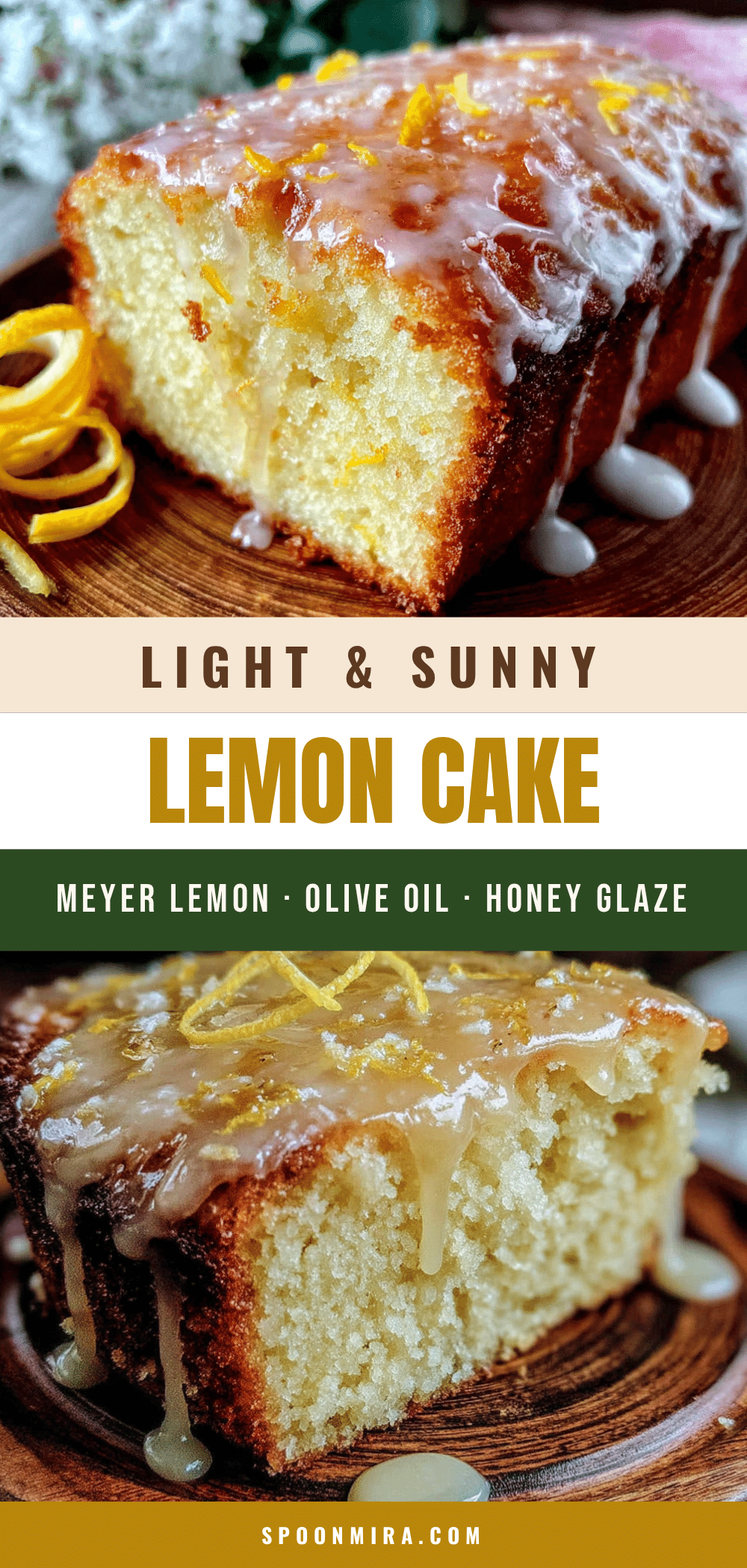
Light and Sunny Meyer Lemon Olive Oil Cake with Honey Glaze

This bright, tender olive oil cake features sweet Meyer lemons and a honey glaze that soaks into the warm cake. It’s quick to make with simple ingredients and perfect for spring gatherings or a special treat.
- Prep Time: 15 minutes
- Cook Time: 35-40 minutes
- Total Time: 50-55 minutes
- Yield: 10 servings 1x
- Category: Dessert
- Cuisine: American
Ingredients
- 2–3 medium Meyer lemons (zest and juice)
- ¾ cup (180 ml) extra-virgin olive oil
- ⅓ cup (110 g) honey (plus 3 tablespoons for glaze)
- ¾ cup (150 g) granulated sugar
- 3 large eggs, at room temperature
- 1½ cups (190 g) all-purpose flour
- 1½ teaspoons baking powder
- ¼ teaspoon salt
- ½ cup (120 g) plain Greek yogurt
- 1 cup (120 g) powdered sugar (for glaze)
- Optional garnish: fresh thyme sprigs or edible flowers
Instructions
- Preheat oven to 350°F (175°C). Grease a 9-inch round cake pan and line the bottom with parchment paper.
- Zest 2 Meyer lemons, then juice them to get ¼ cup (60 ml) juice. Set aside.
- In a large bowl, combine ¾ cup (150 g) granulated sugar and lemon zest. Rub zest into sugar with your fingers until fragrant. Add 3 room-temperature eggs and whisk vigorously for about 1 minute until pale and thick.
- Slowly drizzle in ¾ cup (180 ml) olive oil while whisking continuously until smooth and glossy. Whisk in ½ cup (120 g) Greek yogurt and 2 tablespoons of the Meyer lemon juice.
- In a separate bowl, whisk together 1½ cups (190 g) all-purpose flour, 1½ teaspoons baking powder, and ¼ teaspoon salt. Add dry ingredients to wet mixture in two additions, folding gently until just combined.
- Pour batter into prepared pan and smooth the top. Bake for 35-40 minutes, or until a toothpick inserted in the center comes out clean. Let cool in pan for 10 minutes, then invert onto a cooling rack and remove parchment.
- While cake bakes, make glaze: In a small saucepan over low heat, warm 3 tablespoons honey and 1 tablespoon Meyer lemon juice until runny. Remove from heat and whisk in 1 cup (120 g) sifted powdered sugar until smooth.
- While cake is still warm (but not hot), pour glaze over top and spread gently. Let cool completely before slicing.
Notes
Bring all ingredients to room temperature for best results. Don’t skip the zest-sugar rub—it releases lemon oils for maximum flavor. Let cake cool 10 minutes before glazing to prevent glaze from sliding off. Store at room temperature in an airtight container for up to 4 days. Freezes well (unglazed) for up to 3 months.
Nutrition
- Serving Size: 1 slice
- Calories: 320
- Sugar: 24
- Sodium: 120
- Fat: 18
- Saturated Fat: 3
- Carbohydrates: 38
- Fiber: 1
- Protein: 5
Keywords: Meyer lemon, olive oil cake, honey glaze, lemon cake, spring dessert, easy cake